From Intent to Integration

There is a significant difference between having an inclusion policy and maintaining an inclusion practice. A policy can be drafted, approved, and filed away. A practice, on the other hand, is a living organism that requires ongoing attention, reflection, and refining. It grows with an organisation, responds to the people within it, and adapts as needs evolve.

It is alive.


At that point, inclusion becomes less about what an organisation claims and more about who it is. It shows up in how you hire, communicate, make decisions, design systems, and build relationships. It becomes inseparable from your values, your internal culture, and your daily reality.


Integration marks the shift from performative intention to embodied identity.


This training package explores how your current systems, spaces, and habits impact safety, energy, and retention, and how small, intentional shifts can unlock collective potential.

What makes this different?
 

Rooted in lived experience: Built from the real, messy reality of navigating workplaces, not abstract textbook theories.


Focused on everyday change: No grand, overwhelming overhauls, just practical habits you can start shifting tomorrow.


Deeper than checklists: We move past basic awareness to look at the structural changes that actually matter.


Designed for lasting safety: We focus on building a culture where no one has to waste energy hiding who they are, allowing everyone to just be themselves and do their best.

Why does it matter?


Because when neurodivergent staff feel safe, supported, and truly heard, they don’t have to mask or spend all their energy just surviving the workday. They can spend it collaborating, creating, and staying—and building a workplace that is healthier, kinder, and sustainable for everyone.
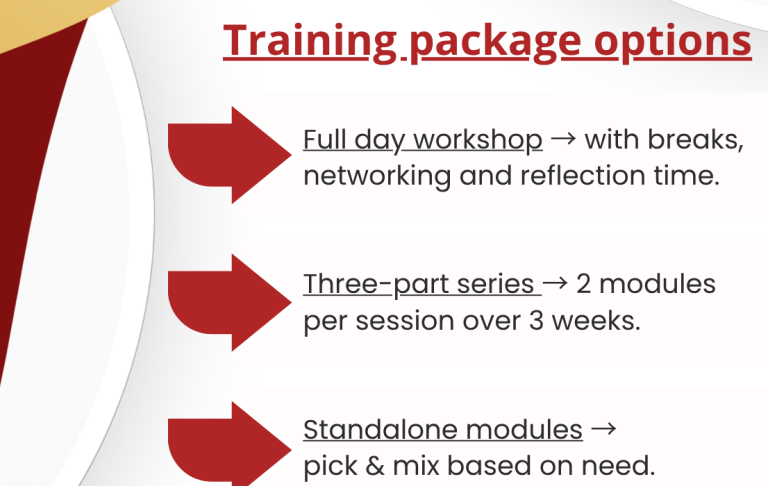
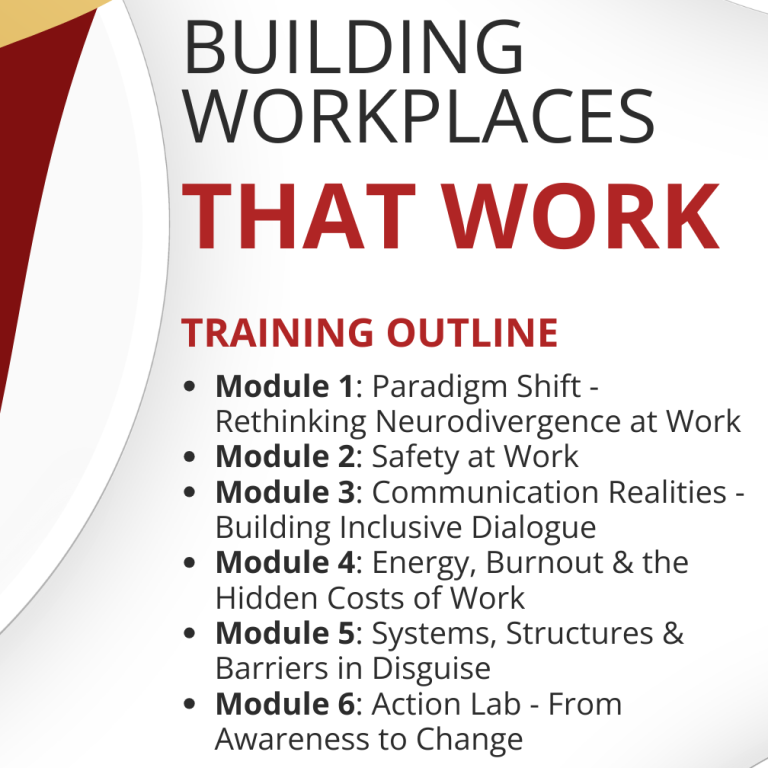
The Things You Can't See

Most workplace diversity training focuses on surface-level accommodations... a quiet desk here, an extra break there. But if you’re only looking at observable behaviours, you’re missing the actual story.


This 2h session is designed to disrupt traditional assumptions about neurodivergence at work.

We move past basic awareness to unpack the hidden internal mechanics, the invisible cognitive load, and why standard workplace advice so often falls flat.


What we'll unpack: 

  • The deconstruction - you've been looking at the wrong things. The goal with this is to disrupt traditional assumptions around neurodivergence and workplace behaviours
  • The hidden mechanics - the why beneath what's observable. Will be looking at explaining the internal mechanics behind common workplace misunderstandings
  • The human cost - helping people understand the exhausting reality of constant adaptation
  • Why “just ask for help!” often fails

Ideal for: Leaders, HR professionals, and team members ready to look beyond surface-level awareness and create truly inclusive cultures.


What makes it different?
 

Lived experience over textbooks: Designed around the invisible, daily realities of neurodivergent professionals, not corporate theory.


Micro-shifts over overhauls: Focuses on immediate, practical changes to how you communicate, delegate, and support.


Mechanics over checklists: Goes beyond "what neurodiversity is" to explain why common workplace interactions break down and how to fix them.


Psychological safety over compliance: Creates an environment where people can stop burning out from constant masking and start channelling that energy into their work.

Why does it matter?


The cost of constant adaptation is invisible, but it’s real, leading straight to burnout, detachment, and lost talent.

Creating a truly inclusive environment is about making work a place where people don't have to exhaust themselves just to exist and show up.

When we build safety into the everyday culture, everyone gets to save their energy for what actually matters.

Building psychological safety

Most organisations treat psychological safety as an interpersonal issue, meaning something to be solved with good intentions, empathy, and surface-level awareness. But goodwill doesn't fix broken workplace systems.


When your default communication channels, meeting structures, feedback loops, and physical environments are built for a narrow norm, you create unnecessary risk, hidden friction, and cognitive exhaustion.


This 3h workshop moves psychological safety from soft culture talk into hard operational design by treating psychological safety as core organisational infrastructure.


We will look at: 

  • Why psychological safety is an infrastructure issue
  • Where workplaces create unnecessary risk
  • From individual adjustment to universal infrastructure
  • Communication infrastructure
  • Meeting infrastructure
  • Feedback & performance infrastructure
  • Workflow & decision-making infrastructure
  • Sensory, environmental & recovery infrastructure
  • Disclosure & support infrastructure
  • The infrastructure audit
  • Build it in: your 30 day plan
  • From good intentions to better infrastructure


What makes it different?
 

Focuses on systems: we redesign the operational architecture - meetings, workflows, and feedback loops.


Universal infrastructure over individual adjustments: we shift the strategy away from endless, one-off individual accommodations toward building a accessible baseline environment that works for diverse minds by default.


Removes the burden of disclosure: employees shouldn't have to formally disclose a condition or diagnosis to access an environment where they can function well. Built-in infrastructure protects and supports people automatically.


Actionable: this is not a passive lecture on awareness. You will directly audit your organisation's existing risk points across the infrastructure and walk away with a concrete 30-day implementation plan.

Why does it matter?


Ambition and capability mean nothing if operational bottlenecks prevent people from executing. Redesigning infrastructure turns willingness to learn into actual opportunities to perform.

Clear, explicit, and accessible infrastructure lowers operational risk, prevents burnout, reduces errors, and creates a predictable environment.

The Accessible Interview


Traditional interviews don't measure job skill, but rather how well someone interviews.


Standard hiring processes rely heavily on social fluency, rapid verbal recall, and performance under artificial pressure. 


This inadvertently creates invisible barriers that obscure candidates' actual technical and operational capabilities.


The Accessible Interview is a practical, 1.5 hour session designed to dismantle the artificial barriers.


This session equips teams to redesign their interview formats. You'll learn how to strip away cognitive friction, remove bias toward social mirror-imaging, and build an evaluation process that captures clear, accurate data on candidate talent.

What makes it different?


Focuses on accuracy over performance: we teach how to remove artificial friction so you can accurately assess real job capability.


Hands-on question & task redesign: rather than just discussing theory, participants engage in an interactive discussion to directly deconstruct and rewrite multi-barreled, high-cognitive-load interview questions into clear, job-focused prompts.


Immediate, zero-cost implementation: The session delivers a checklist of operational changes, like pre-interview cheat sheets, chat anchors, and question sharing, that managers can apply immediately.


Tackles manager pushback: directly addresses common leadership anxieties to build genuine buy-in for accessible hiring.

Why does it matter?


Standard interviews systematically filter out highly capable, neurodivergent, or introverted candidates who excel at the job but struggle with social performance tests.


Better assessment methods yield better predictive data on performance, drastically reducing the cost of bad hires and drawn-out probationary periods.

©Copyright NDwise Hub 2025. All rights reserved.

Information icon

We need your consent to load the translations

We use a third-party service to translate the website content that may collect data about your activity. Please review the details in the privacy policy and accept the service to view the translations.